Restorative Dentistry
Dental implants replace missing or severely damaged teeth with something that looks, feels and functions much like a natural tooth. Whether you are missing a single tooth or need a full arch replaced, an implant is a durable, long-term option that restores both the function and the appearance of your smile, and the crown that goes on top is made in our own lab.
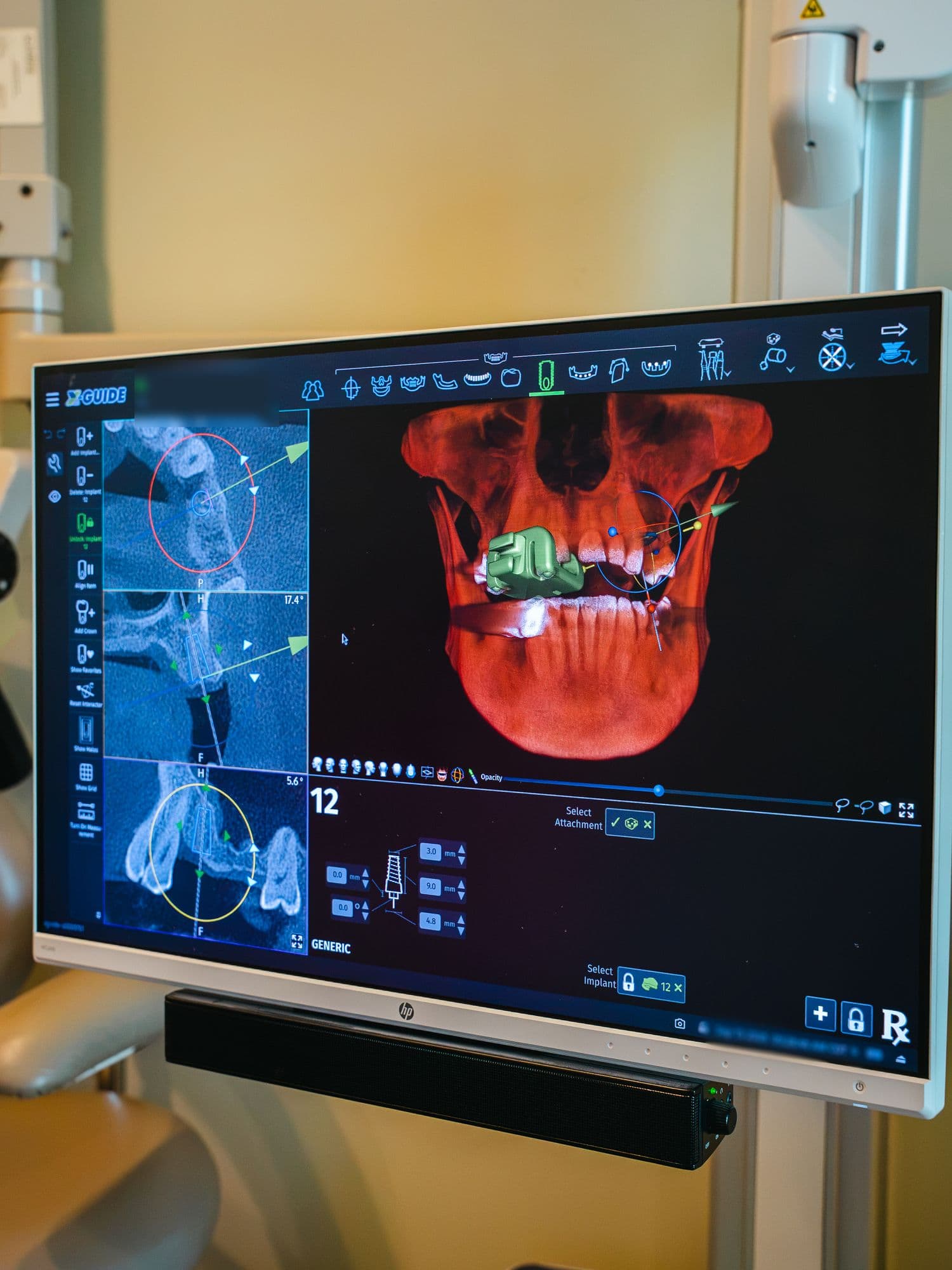
What are dental implants?
A dental implant is a titanium post that is surgically placed into your jawbone, where it acts as a replacement for the root of a missing tooth. After the implant fuses with the bone in a process called osseointegration, a custom-made crown from our in-house lab is placed on top of the implant, restoring the appearance and function of the missing tooth.
Benefits of dental implants
Natural appearance
Implants blend seamlessly with your natural teeth and are virtually indistinguishable from real teeth.
Durability
Dental implants are designed to last for decades with good care, and they are the longest-lasting option for replacing a missing tooth. Like natural teeth, they depend on healthy gums and bone around them.
Improved function
Implants restore full chewing and speaking ability, so you can enjoy all the foods you love without worry.
Preserved jawbone
Since implants stimulate the jawbone like natural tooth roots, they help prevent bone loss and preserve your facial structure.
The dental implant process
Consultation
Your treatment begins with a thorough consultation, including a detailed exam and X-rays, to determine if dental implants are the right option for you.
Placement
The titanium post is surgically placed into your jawbone, where it will gradually fuse with the bone.
Healing
After the implant is securely integrated into the bone, we take impressions of your mouth to create a custom crown.
Restoration
Once the crown is ready, crafted right here in our in-house lab for a precise, custom fit, it is placed on the implant to complete your restoration, giving you a fully functional and natural-looking tooth.
Are you a candidate?
Most people who have lost a tooth can have an implant, but not everyone, and it is better to know why before you get attached to the idea.
Enough healthy bone
The implant post needs bone to hold it. Bone starts shrinking as soon as a tooth is gone, so the longer a gap has been there, the more likely grafting is needed first. This is the commonest thing that changes a treatment plan.
Gums free of active disease
Gum disease has to be treated and stabilised before implants are placed. Putting an implant into an infected mouth risks losing it, so periodontal treatment comes first where it is needed.
General health that allows healing
Uncontrolled diabetes, some medications including certain bone treatments, and recent radiotherapy to the jaw all affect healing. Tell us what you take and what you are being treated for, including things that seem unrelated.
Not smoking, ideally
Smoking measurably raises the risk of implant failure. It does not automatically rule treatment out, but you should know the odds are different, and we will tell you so rather than letting you find out afterwards.
Finished growing
Implants are not usually placed in teenagers whose jaws are still developing, because the implant stays where it is put while the surrounding bone continues to change.
What the treatment actually involves, stage by stage
Implant treatment is measured in months rather than visits, and most of that time is healing rather than appointments.
Assessment and planning
An examination, appropriate dental imaging and a conversation about your goals. RAYFace captures the surface of the face to help discuss appearance; it does not replace imaging used to assess teeth and jawbone. Ask who provides each stage and what the written estimate includes.
Preparation, if it is needed
Removing a failing tooth, or grafting bone where there is not enough. Grafting adds months to the timeline because the graft has to integrate before the implant can go in.
Placing the implant
A minor surgical procedure under local anaesthetic. The post is placed into the bone and the gum closed over or around it. Most people describe the days afterwards as comparable to having a tooth out.
Healing and integration
Bone needs time to integrate with the implant. Timing varies by case; some treatment plans allow an earlier restoration while others require several months of healing. Your dentist will explain the sequence and follow-up for your situation.
Abutment and crown
Once the implant is stable, the connector goes on and the crown is made to match your other teeth. Because our lab is in the building, that crown is made here and adjusted here.
Reviews afterwards
Implants need checking and cleaning like natural teeth. The gum around an implant can become inflamed and, left alone, that can cost you the implant.
Risks and what can go wrong
Implants have a high success rate, and they are not certain. Being straight about that is part of consenting to treatment properly rather than a disclaimer at the bottom of a page.
An implant can fail to integrate with the bone, most often in the first months, and it then has to be removed and the site allowed to heal before trying again. Peri-implantitis, which is inflammation of the gum and bone around an implant, behaves much like gum disease and is the main long-term threat. Nerve irritation and sinus involvement are recognised risks in particular positions in the jaw, which is exactly what the three-dimensional imaging is for.
Smoking, uncontrolled diabetes, grinding and poor cleaning all raise the risk. Regular check-ups and cleaning around the implant are what keep it, and that is not a formality.
The alternatives, fairly described
An implant is not automatically the right answer, and a practice that never says so is selling rather than advising.
A bridge
Faster and usually less expensive. The cost is that the healthy teeth either side of the gap are reshaped to carry it, and the bone under the gap keeps shrinking.
A partial denture
The least expensive option and the least fixed. It comes out for cleaning, and it takes adjusting to, but it changes nothing irreversibly and can be a sensible staging post.
An implant-supported denture
Where several teeth or a whole arch are involved, a small number of implants can secure a denture. Considerably more stable than a conventional one and considerably less expensive than replacing every tooth individually.
Leaving the gap
Sometimes reasonable, particularly at the back of the mouth. The trade-off is that neighbouring teeth drift into the space over time and the bone continues to shrink, which narrows your options later.
Dental Implants Questions
An implant has three separate parts: a post placed into the jawbone, an abutment that connects to it, and a crown on top that you see. The post needs time to fuse with the bone before the final crown goes on, which is why implant treatment runs over months rather than a single visit.
Cost varies by case rather than sitting at one figure, because it depends on how many teeth are involved, whether bone grafting is needed first, and which materials are used. We will give you a written breakdown showing what each part covers before you decide anything.
Implants are designed to last for decades and many do, provided the gums and bone around them stay healthy. They are not immune to problems: implants can fail, particularly where gum disease or smoking is involved, and they need the same regular care as natural teeth.
The main requirements are enough healthy bone to hold the post and gums free of active disease. Smoking, uncontrolled diabetes and some medications make implants harder to place successfully. Where bone has already been lost, grafting can sometimes make treatment possible.
An implant stands on its own without altering neighbouring teeth and helps preserve the bone where the tooth was, which a denture does not. It also costs more and takes longer. Which is better genuinely depends on your situation, and we would rather talk it through than push one option.
Before your visit
Answers to help you plan your care
Missing teeth
Implants, bridges or partial dentures: how to compare missing-tooth options
The right question is which replacement fits your mouth and your priorities. Start with the differences, then bring these questions to your consultation.
Costs
Dental implant costs in North Mississippi: what affects your estimate?
Most implant cost articles quote one national average that may have nothing to do with your case. This one explains what the number is actually made of, so you can read an estimate properly.
Comparisons
Full dentures or implant-supported dentures: which one fits your life?
Both replace a full arch of teeth, and they suit different people for reasons that have little to do with which is better. Here is the comparison, set out plainly.
More Restorative Dentistry
Crowns & Bridges
If you have damaged or missing teeth, crowns and bridges are an excellent way to restore both the function and appearance of your smile. At Park Place Dental, we focus not only on strength and durability, but also on creating natural-looking, cosmetic results that help you feel confident every time you smile.
Learn moreDentures
Dentures are a reliable and affordable solution for individuals who have lost multiple teeth. Whether you are missing a few teeth or an entire set, dentures can restore both the appearance and function of your smile, allowing you to eat, speak, and smile with confidence once again.
Learn more
Dental implants are a life-changing solution for missing teeth. With our in-house lab, we are able to deliver high-quality restorations with fewer appointments and less wait time. Contact Park Place Dental today to schedule your consultation.